Hotel Energy Monitoring System: Find Hidden Energy Waste
A hotel energy monitoring system helps hotel teams see where, when and how energy is being consumed. Learn how monitoring can uncover HVAC waste, identify abnormal consumption, establish baselines and support better energy-management decisions.
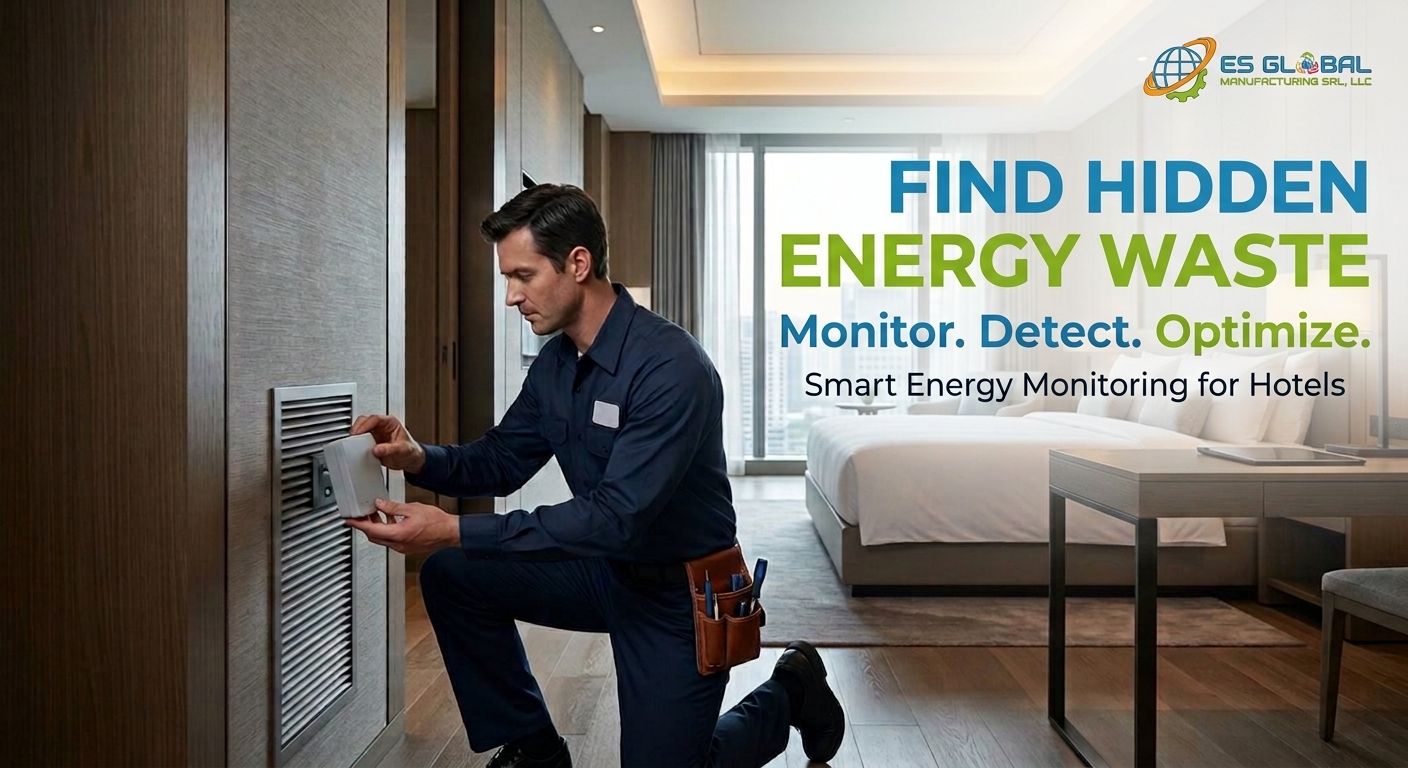
Hotel Energy Monitoring System: How Hotels Can Find and Reduce Hidden Energy Waste
A hotel's monthly utility bill tells you how much energy you used.
It doesn't necessarily tell you:
Where the energy went.
Or:
Why consumption increased.
Or:
Which rooms, systems or equipment are responsible.
That distinction matters.
If electricity consumption rises by 12% from one month to the next, a hotel owner needs more than a larger bill.
The engineering team needs to know whether the increase came from:
- HVAC,
- guestrooms,
- laundry,
- kitchen equipment,
- hot water,
- lighting,
- common areas,
- equipment faults,
- operating schedules,
- or simply higher occupancy.
This is where a hotel energy monitoring system becomes valuable.
Instead of looking at energy consumption as one large number, monitoring technology can give hotel teams greater visibility into when, where and how energy is being consumed.
And once the hotel can see the problem, it becomes much easier to decide what should be fixed.
Why Hotel Energy Bills Don't Tell the Whole Story
Consider two hotels.
Hotel A
Monthly electricity cost:
$80,000
Hotel B
Monthly electricity cost:
$80,000
At first glance, they appear identical.
But suppose Hotel A has:
- higher occupancy,
- more guestrooms,
- more restaurants,
- larger common areas,
- and a higher operating load.
Hotel B has fewer rooms and lower occupancy.
The same monthly bill could represent very different levels of operational efficiency.
That's why hotel energy management requires more than reading the utility bill.
Hotels need context.
They need to understand:
Consumption + occupancy + weather + operating conditions + equipment behavior.
What Is a Hotel Energy Monitoring System?
A hotel energy monitoring system is a technology platform that collects and presents energy-consumption data so hotel teams can understand how energy is being used across the property.
Depending on the system, monitoring may cover:
- electricity
- HVAC
- guestrooms
- floors
- buildings
- kitchens
- laundry
- water
- gas
- major mechanical equipment
The data can then be displayed through dashboards, reports and alerts.
The basic process is:
Measure → Collect → Analyze → Identify → Act → Verify
The important word is measure.
Without measurement, an energy-saving project is often based on assumptions.
With measurement, the hotel can establish a baseline and determine whether an intervention actually changed consumption.
How Does Hotel Energy Monitoring Work?
A typical monitoring architecture can contain several layers.
1. Main Energy Meter
The main meter provides a high-level view of the property's consumption.
It answers:
How much energy is the hotel using?
But it doesn't necessarily explain why.
2. Submeters
Submeters divide the property's energy consumption into more useful categories.
For example:
- guestrooms
- HVAC plant
- kitchen
- laundry
- pool
- restaurant
- common areas
Now the engineering team can ask a much better question:
Which part of the hotel is responsible for the increase?
3. Room-Level Monitoring
For hotels focused heavily on guestroom HVAC, room-level information can provide another layer of visibility.
Instead of seeing:
Hotel electricity = X
the system may help identify:
Floor 3 → Room 312 → HVAC operating pattern
That level of visibility can make it easier to investigate unusual consumption.
4. HVAC Monitoring
HVAC deserves special attention because heating and cooling can represent a significant hotel energy load.
Monitoring can help engineering teams understand:
- operating hours
- temperature patterns
- abnormal runtime
- room status
- equipment behavior
- potential control problems
A monitoring system doesn't automatically make an inefficient HVAC system efficient.
But it can make the inefficiency visible.
5. Central Dashboard
The collected data needs to be presented in a useful way.
A good dashboard should help users quickly answer:
- What is happening now?
- What changed?
- Where is the problem?
- How serious is it?
- What should we investigate?
Modern hospitality EMS platforms increasingly emphasize real-time dashboards, room status, equipment information, alarms and performance analytics. Honeywell's INNCOM EMS, for example, provides property, room and portfolio-level monitoring and analytics.

What Can Hotels Discover With Energy Monitoring?
The real value of monitoring isn't the dashboard itself.
It's the decisions the data enables.
1. HVAC Running in Vacant Rooms
Suppose several guestrooms remain vacant for hours while their HVAC systems continue operating at normal comfort settings.
Without room-level visibility, the issue may remain hidden.
Monitoring can help identify the pattern.
The hotel can then consider:
- occupancy-based control
- temperature setback
- scheduling
- PMS integration
- HVAC automation
This connects directly with ES Global's occupancy-based HVAC solution discussed in Article #1.
2. Abnormal Equipment Consumption
A piece of equipment that normally operates within a predictable range suddenly begins consuming significantly more energy.
That doesn't automatically mean the equipment is faulty.
But it creates a reason to investigate.
Possible causes might include:
- degraded equipment
- control problems
- excessive runtime
- maintenance issues
- changes in operating conditions
Energy data can therefore become an early warning signal.
3. Unexpected Energy Spikes
Energy monitoring can help identify unusual consumption periods.
For example:
Normal overnight consumption
↓
Unexpected 2:00 AM spike
↓
Engineering investigation
↓
Equipment/schedule issue identified
↓
Corrective action
Without granular data, the hotel may only discover the problem after seeing the monthly bill.
4. After-Hours Consumption
Some hotel systems need to operate continuously.
Others don't.
Monitoring can reveal how much energy the property consumes during periods of low activity.
This is especially useful for:
- meeting rooms
- offices
- restaurants
- back-of-house spaces
- lighting
- selected HVAC zones
5. Seasonal Changes
Hotels often experience large seasonal variations.
Cooling demand may rise during hot weather.
Heating demand may rise during colder periods.
Energy monitoring allows teams to compare consumption across different periods and determine whether changes are reasonable or abnormal.
Hotel Energy Monitoring vs. Hotel Energy Management
These terms are often used interchangeably, but there is an important difference.
Energy Monitoring
Shows what is happening.
Energy Management
Uses information and controls to change what is happening.
For example:
Monitoring
Room 214 has unusually high HVAC runtime.
Management
Room 214 is vacant, so HVAC automatically enters an energy-saving mode.
Monitoring provides visibility.
Management adds action.
The two work best together.
Why HVAC Monitoring Matters So Much in Hotels
Hotels have an unusual HVAC challenge.
Guestroom demand changes constantly.
One room may be occupied.
The room next door may be vacant.
A third room may have a guest who left for dinner.
Another may have a late-night arrival.
The hotel still needs to maintain acceptable comfort.
That makes room-level HVAC management fundamentally different from simply scheduling HVAC for an office building.
Research into real-time hotel guestroom energy management has specifically examined platforms that combine monitoring, alerts and analytics with indoor-environment information to help facility managers make timely decisions while maintaining occupant comfort.
For hotel engineering teams, this means energy monitoring can become more than an accounting function.
It can become an operational tool.
How Energy Monitoring Helps Hotel Engineering Teams
A Director of Engineering doesn't need another dashboard full of meaningless graphs.
The system needs to help answer operational questions.
Before monitoring
"The electricity bill is higher this month."
With monitoring
"Guestroom HVAC consumption increased 14% on the third floor."
Better still
"Six rooms have abnormal HVAC runtime compared with similar occupied rooms."
That progression is where energy analytics becomes useful.
It turns an abstract utility cost into a maintenance or operational decision.

How Hotel Owners Can Use Energy Data for ROI Decisions
Suppose a hotel is considering a new HVAC control system.
Without a baseline, the conversation might sound like:
"The system can save 20%."
But 20% of what?
And how will the hotel know the savings actually occurred?
A better process is:
Step 1 — Establish baseline
Measure current consumption.
Step 2 — Identify controllable load
Determine how much of the consumption can realistically be affected.
Step 3 — Implement the solution
Install the control or efficiency measure.
Step 4 — Continue monitoring
Track performance after implementation.
Step 5 — Compare
Compare actual consumption against the baseline while accounting for relevant operating conditions.
This gives the hotel a stronger basis for calculating ROI.
7 Metrics Hotels Should Monitor
1. Total Energy Consumption
The basic property-level metric.
2. Energy Consumption by Area
Compare:
- guestrooms
- HVAC plant
- kitchen
- laundry
- common areas
3. Energy per Occupied Room
This provides more context than total consumption alone.
4. HVAC Runtime
Useful for identifying excessive operation.
5. Peak Demand
Important where utility pricing is influenced by demand.
6. After-Hours Consumption
Helps identify unnecessary overnight operation.
7. Energy Trend
Track consumption over:
- days
- weeks
- months
- seasons
- occupancy periods
The objective isn't to collect the maximum possible data.
It is to collect actionable data.
What Should Hotels Look for in an Energy Monitoring System?
Not all systems provide the same level of visibility.
Hotel operators should evaluate:
Real-time monitoring
Can engineering teams see what's happening now?
Historical data
Can they compare current performance with previous periods?
Room-level visibility
Can the system identify individual rooms or zones?
Alerts
Can abnormal conditions trigger notifications?
HVAC integration
Can energy information be connected to HVAC operation?
PMS integration
Can room occupancy and reservation information be incorporated?
Reporting
Can management generate useful reports?
Scalability
Can the system expand from one property to multiple properties?
Data ownership
Can the hotel access its own historical data?
Ease of use
Can engineering staff actually use the platform without excessive training?
Does Energy Monitoring Require a New Building Management System?
Not necessarily.
A hotel may already have:
- BMS
- EMS
- smart thermostats
- standalone meters
- HVAC controls
The appropriate monitoring architecture depends on what is already installed.
A BMS is generally focused on broader building systems.
A room-level energy-management system may focus more heavily on guestroom HVAC and occupancy.
These systems can be complementary rather than mutually exclusive.
Current hospitality solutions demonstrate both approaches: property-wide platforms can provide centralized energy visibility, while room-level systems can focus on guestroom HVAC and occupancy.
Can Hotels Monitor Energy Without Replacing Existing HVAC Equipment?
Often, the answer depends on the property's existing infrastructure.
Monitoring can sometimes be added without replacing major HVAC equipment.
That makes it important to distinguish between:
Monitoring
and
Equipment replacement.
A hotel might first add measurement and analytics, discover where the largest opportunity exists, and then determine whether controls, maintenance or equipment replacement is the appropriate next step.
This can produce a more disciplined capital-planning process.
Energy Monitoring Is Especially Valuable Before a Major Retrofit
Imagine a hotel is considering replacing a large amount of HVAC equipment.
Before spending heavily, management could investigate:
- current energy consumption
- equipment runtime
- room occupancy
- temperature patterns
- maintenance history
- peak loads
- problem areas
This data can help determine whether the project should focus on:
equipment replacement
or:
controls + optimization
or:
both.
The answer should come from the property's data.
How ES Global Fits Into Hotel Energy Management
ES Global's competitive analysis positions the company around hotel room energy management, particularly its EHA system.
The supplied competitive research describes EHA as a wireless, thermostat-free energy-saving system that does not require thermostat replacement and is designed to work across A/C types. It also identifies wireless installation and keeping rooms live during installation as part of the product positioning.
The research also identifies ES Global's current digital weakness:
- very low estimated organic traffic
- minimal thought leadership
- no blog/content marketing
- basic knowledge resources
while competitors are investing more heavily in technical resources, analytics and digital marketing.
That creates an important content opportunity.
ES Global doesn't need to compete with large technology companies by publishing generic product pages.
It can build authority by answering practical questions hotel engineering and ownership teams actually face:
Where is energy being wasted?
How do we measure it?
Which loads should we control?
How do we verify savings?
How do we improve hotel energy efficiency without disrupting guests?
That's the role this article should play.
A Practical Hotel Energy Monitoring Roadmap
Hotels don't need to monitor everything on day one.
A practical approach is:
Phase 1 — Establish the Baseline
Start with:
- utility bills
- occupancy
- room count
- major energy loads
- operating schedules
Phase 2 — Identify Critical Loads
Determine which systems deserve deeper visibility.
For many hotels, this may include:
- HVAC
- guestrooms
- central plant
- kitchen
- laundry
- hot water
Phase 3 — Install Appropriate Measurement
Use meters or sensors where additional data can materially improve decision-making.
Phase 4 — Build Useful Dashboards
Avoid information overload.
Prioritize:
- consumption
- trends
- anomalies
- alerts
- comparisons
Phase 5 — Take Action
Use the data to identify:
- maintenance issues
- scheduling problems
- HVAC waste
- control opportunities
- equipment upgrades
Phase 6 — Verify Results
After implementing an energy-saving measure, continue monitoring.
The project isn't complete when the equipment is installed.
It is complete when the hotel can demonstrate what changed.
The Goal Isn't More Data. It's Better Decisions.
Hotels can collect enormous amounts of information.
But data alone doesn't reduce the utility bill.
The real value comes from the chain:
Data → Insight → Action → Measurement
For example:
Data: Guestroom HVAC runtime is high.
↓
Insight: Several rooms remain conditioned during extended vacancy.
↓
Action: Implement occupancy-based HVAC control.
↓
Measurement: Compare post-control performance against baseline.
That's energy management.
Final Takeaway
A hotel energy monitoring system can give hotel owners and engineering teams something a monthly utility bill cannot:
visibility.
It can help answer:
- Where is energy being consumed?
- When is consumption increasing?
- Which areas are using more than expected?
- Is HVAC operating unnecessarily?
- Are energy-saving projects actually working?
- Where should the hotel invest next?
But monitoring should not become an end in itself.
The strongest hotel energy strategy connects:
Measurement → Monitoring → Control → Optimization → Verification.
For hotels trying to reduce operating costs, that means the first step isn't necessarily buying another piece of equipment.
It may simply be getting a clearer picture of what the property is already doing.
Once the hotel can see where energy is going, it can make much better decisions about where to save it.
Frequently asked questions
What is a hotel energy monitoring system?
A hotel energy monitoring system collects and analyzes energy-consumption data from different parts of a hotel so owners and engineering teams can understand where, when and how energy is being used.
Why do hotels need energy monitoring?
Utility bills provide total consumption but usually don't provide enough detail to identify specific sources of waste. Energy monitoring can provide more granular information that helps hotels identify abnormal consumption and prioritize efficiency projects.
What can a hotel energy monitoring system measure?
Depending on the system, it can monitor electricity, HVAC consumption, guestrooms, floors, major equipment, water and other energy-related loads.
What is the difference between energy monitoring and energy management?
Energy monitoring provides visibility into consumption. Energy management uses that information, together with controls and operational strategies, to actively optimize energy use.
Can energy monitoring reduce hotel energy costs?
Monitoring itself does not automatically reduce consumption. Its value comes from helping hotel teams identify waste, take corrective action and verify whether energy-saving measures produce results.
Can hotel energy monitoring work with an existing BMS?
Potentially. The answer depends on the existing BMS, meters, controls and integration architecture. Monitoring systems can sometimes complement an existing BMS rather than replace it.
Should hotels monitor guestrooms separately?
For many properties, guestroom-level monitoring can be valuable because occupancy and HVAC operation vary considerably from room to room. It can help identify unusual consumption and support room-level energy-management strategies.
What should hotels measure before installing an energy-saving system?
At minimum, establish a baseline of energy consumption and collect relevant operational information such as occupancy, room count, HVAC configuration and operating schedules. This creates a reference point for evaluating future savings.
More from the blog

What Empty Hotel Rooms Cost You in HVAC Waste | ES Global
Learn how to estimate what unoccupied hotel rooms are costing your property in wasted HVAC energy, u...
Hotel Energy Efficiency Solutions: 15 Ways to Reduce Energy Costs
Explore 15 practical hotel energy efficiency solutions that can reduce HVAC, lighting, water heating...

Hotel Occupancy-Based HVAC Control: Save Energy
Discover how hotel energy monitoring systems help identify hidden energy waste, track HVAC and room-...