Hotel Occupancy-Based HVAC Control: Save Energy
Discover how hotel energy monitoring systems help identify hidden energy waste, track HVAC and room-level consumption, and turn energy data into actionable savings and smarter operational decisions.

Hotel Occupancy-Based HVAC Control: How It Saves Energy Without Sacrificing Guest Comfort
A hotel guestroom does not stop consuming HVAC energy simply because the guest leaves for dinner.
For hours at a time, a room can remain heated or cooled even though nobody is inside it. Across dozens or hundreds of guestrooms, that unnecessary runtime becomes a recurring operating expense.
Hotel occupancy-based HVAC control addresses that problem by allowing the HVAC system to respond to whether a room is actually occupied.
Instead of treating every room as occupied all day, the system can adjust HVAC operation when a guest leaves, then restore the room toward a comfortable condition when the guest returns.
The goal isn't simply to turn air conditioning off.
The goal is to condition guestrooms intelligently according to occupancy while protecting guest comfort.
What Is Occupancy-Based HVAC Control in a Hotel?
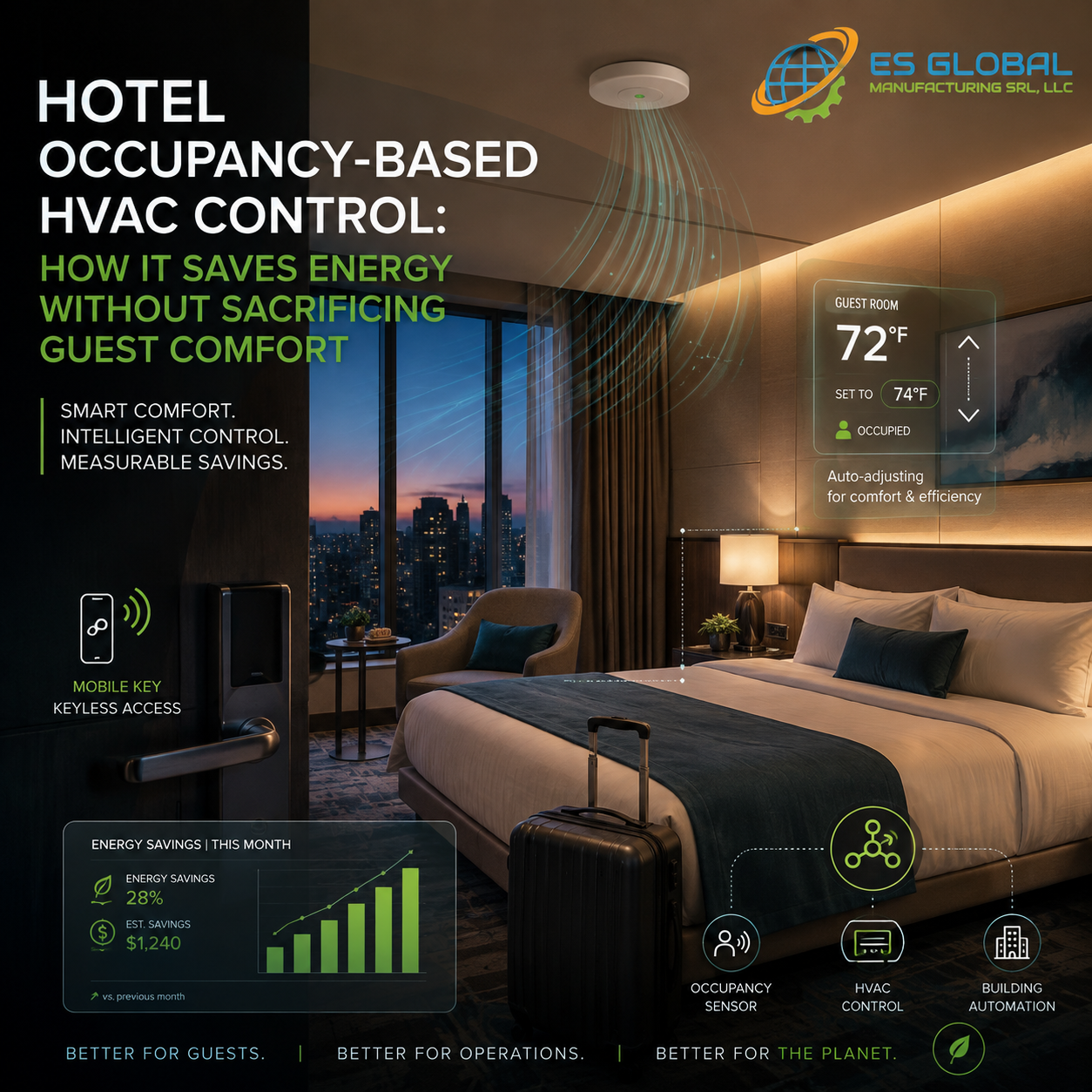
Occupancy-based HVAC control is an automated approach that changes heating or cooling behavior based on whether a hotel guestroom is occupied.
A conventional thermostat primarily responds to the temperature selected by the user.
An occupancy-based system adds another layer of intelligence:
Is anyone actually using this room right now?
When the room is occupied, the system can maintain normal comfort settings.
When the room becomes vacant, the system can move to an energy-saving operating mode rather than continuously conditioning an empty space.
When the guest returns, the system can restore the room toward the desired comfort range.
This creates a simple operating logic:
Occupied → Comfort mode
Vacant → Energy-saving mode
Guest returns → Recovery
The exact control strategy depends on the HVAC equipment, hotel operating requirements and system configuration.
Why Do Hotel Guestrooms Waste HVAC Energy?
Hotels have a particularly difficult energy-management challenge: guestrooms operate according to guest behavior, not a predictable office schedule.
A guest might:
- leave the room for several hours
- sleep while the room remains conditioned
- check out earlier than expected
- leave a room temporarily during the day
- leave the balcony door open
- change the thermostat significantly
Meanwhile, the HVAC equipment may continue operating according to its previous settings.
ENERGY STAR notes that hotels operate around the clock and contain multiple energy-intensive spaces, including guestrooms, restaurants, kitchens, laundries, pools and common areas. Its hotel guidance specifically identifies heating and cooling as a major energy-use category.
This makes guestroom HVAC control particularly attractive: the system can respond to actual room conditions rather than relying entirely on fixed schedules.
How Hotel Occupancy-Based HVAC Control Works
A typical system combines several components.
1. Occupancy detection
Sensors determine whether the room is occupied.
Depending on the system, occupancy information may come from motion/presence sensing, door status, room controls or other signals.
This matters because simply detecting that a door closed isn't the same as knowing whether a guest is still inside.
2. HVAC control
The energy-management system communicates with the room's HVAC equipment or control interface.
When the room is occupied, normal temperature control can remain active.
When the room becomes vacant, the system can apply a predefined energy-saving strategy.
3. Temperature setback
Rather than maintaining the exact occupied-room temperature indefinitely, the system can allow the room temperature to move within an acceptable range.
This reduces unnecessary heating or cooling while the room is empty.
4. Recovery
When occupancy is detected again, the system can return toward the guest's desired comfort condition.
This recovery stage is critical.
A hotel energy system should not create a room that takes an unreasonably long time to become comfortable.
5. Optional hotel-system integration
More advanced systems can integrate occupancy information with other hotel technology.
ENERGY STAR specifically recommends linking energy-management systems with reservation and automated checkout information so hotels can reduce conditioning in unsold rooms and prepare rooms ahead of guest arrival.
What Happens When a Guest Leaves the Room?
A simplified occupancy-based HVAC sequence looks like this:
Guest enters → Occupied mode → Normal temperature control
↓
Guest leaves → Vacancy detected
↓
HVAC moves to energy-saving settings
↓
Room remains within configured limits
↓
Guest returns → Occupancy detected
↓
HVAC begins recovery
↓
Comfort mode restored
The important point is that vacancy does not necessarily mean switching the HVAC completely off.
A well-designed strategy can use temperature setbacks or wider operating limits instead.
That distinction matters because the objective is to balance:
Energy savings + equipment operation + recovery time + guest comfort.
How Much Energy Can Occupancy-Based HVAC Control Save?
There is no single savings percentage that applies to every hotel.
Results depend on:
- climate
- HVAC equipment
- room occupancy patterns
- existing thermostat settings
- building envelope
- control strategy
- room type
- guest behavior
- installation quality
- measurement methodology
Research summarized by the U.S. Department of Energy's Building Energy Score work reports that studies of occupancy-based hotel controls have found average savings in the range of 10–30% of HVAC energy, although actual results vary by property and methodology.
That is an important distinction:
10–30% of HVAC energy is not the same thing as 10–30% of the hotel's total energy bill.
A credible hotel business case should calculate savings from the property's actual baseline.
Does Occupancy-Based HVAC Control Affect Guest Comfort?
This is one of the most important questions hotel operators should ask.
Energy efficiency is not useful if it produces uncomfortable rooms.
A good system therefore needs to distinguish between:
occupied conditions
and
unoccupied conditions.
When guests are present, their comfort preferences should remain the priority.
When guests are away, the system can use an energy-saving strategy within predefined limits.
When they return, the room should recover appropriately.
Modern hospitality systems commonly use occupancy detection, configurable temperature limits and recovery logic specifically to balance energy efficiency with guest comfort. Verdant, for example, describes occupancy detection, setpoint limits and dynamic recovery as core features of its hotel HVAC approach.
Occupancy Sensor vs. Keycard Energy Saver
Hotels have traditionally used keycard-based energy controls in some properties.
But occupancy-based control takes a different approach.
| Feature | Occupancy-Based HVAC Control | Keycard Energy Switch |
| Detects actual room occupancy | Yes | No |
| Responds automatically | Yes | Limited |
| Works with keyless/mobile access | Yes | Can be problematic |
| HVAC setback | Yes | Basic |
| Guest recovery | Configurable | Limited |
| Central monitoring | Possible | Limited |
| Room-level automation | Strong | Basic |
The distinction becomes increasingly important as hotels move toward mobile keys and keyless guest experiences.
A room should ideally know whether it is occupied without depending entirely on whether a physical keycard is sitting in a wall slot.
Occupancy-Based HVAC vs. Hotel BMS
These technologies are related, but they are not necessarily the same thing.
A Building Management System (BMS) can provide broad building-level control and monitoring.
An occupancy-based guestroom energy-management system focuses more specifically on room-level energy behavior.
A large hotel may use both.
For example:
BMS
→ central plant
→ chillers
→ boilers
→ common areas
→ building systems
Guestroom EMS
→ room occupancy
→ guestroom HVAC
→ room temperature
→ room-level controls
Enterprise platforms can connect these layers. Honeywell's INNCOM offering, for example, describes integration between guestroom energy management, PMS and broader building-management infrastructure.
The right architecture depends on the hotel's existing infrastructure and project objectives.
What Should Hotels Evaluate Before Installing Occupancy-Based HVAC Control?
Technology selection should start with the building—not the product brochure.
HVAC compatibility
Determine what equipment exists in the guestrooms:
- PTAC
- VRF
- split systems
- fan coils
- central HVAC
- other configurations
The control solution needs to work with the actual equipment.
Existing thermostats
Find out whether thermostats need to be replaced or whether the existing setup can be integrated into a retrofit solution.
Occupancy detection
Evaluate how accurately the system can determine room status.
False vacancy detection can create comfort problems.
Installation requirements
For an operating hotel, installation disruption matters.
A system that requires significant room downtime may have a very different business case from a wireless retrofit that can be installed while rooms remain operational.
Monitoring
Ask what data the engineering team will actually receive.
Useful information can include:
- room status
- temperature
- HVAC operation
- alerts
- system performance
- energy trends
Measurement and verification
Before approving a project, establish how savings will be measured.
A credible evaluation should define:
baseline → implementation → measurement → comparison.
Can Hotels Install HVAC Energy Controls Without Replacing Thermostats?
Yes, depending on the HVAC configuration and control technology.
This is particularly relevant for hotels undertaking retrofit projects.
Replacing hundreds of thermostats can increase:
- equipment cost
- installation labor
- room disruption
- project complexity
The ES Global competitive analysis identifies its EHA system as a wireless, thermostat-free energy-saving system, with no thermostat replacement required and compatibility positioned across A/C types. The report also describes turnkey installation and rooms remaining live during installation.
That creates an interesting retrofit proposition for hotels that want better room-level energy control without treating the project as a full thermostat replacement program.
A Practical Implementation Framework for Hotels
Hotels considering occupancy-based HVAC control can approach the project in seven steps.
Step 1: Establish the baseline
Understand current:
- electricity consumption
- HVAC consumption
- occupancy
- room count
- operating patterns
Step 2: Identify the largest opportunity
Look at guestrooms first if they represent a significant controllable load.
Step 3: Audit the HVAC infrastructure
Document the equipment and existing control architecture.
Step 4: Choose the occupancy strategy
Determine how the system will identify:
- occupied rooms
- temporarily vacant rooms
- checked-out rooms
Step 5: Define comfort parameters
Set appropriate:
- occupied temperature ranges
- vacant setbacks
- recovery behavior
- maximum/minimum limits
Step 6: Pilot before scaling
A controlled pilot can reveal:
- actual energy impact
- guest-comfort issues
- installation challenges
- maintenance requirements
Step 7: Measure the result
Compare post-installation performance against the appropriate baseline.
This is more useful than relying exclusively on a generic vendor savings percentage.
The Business Case: Energy Savings vs. Installation Cost
The basic financial model is straightforward:
Annual energy savings − operating costs = annual financial benefit
Then:
Project cost ÷ annual financial benefit = simple payback period
But hotels should go further.
Consider:
- installation cost
- utility incentives
- maintenance
- equipment life
- room downtime
- expected energy-price changes
- HVAC equipment wear
- monitoring costs
- guest-comfort impact
A project that appears inexpensive may have poor long-term value if it is difficult to maintain.
Conversely, a more capable system may produce a stronger business case if it captures more savings and provides useful operational data.
Why Occupancy-Based HVAC Control Is Becoming More Important
Hotel energy management is moving away from simple schedules.
The next generation of hotel controls increasingly uses real operating conditions:
Occupancy
Room status
Temperature
HVAC behavior
Guest preferences
Building conditions
That allows the hotel to move from:
"Run the HVAC according to a schedule."
to:
"Run the HVAC according to what the hotel actually needs."
That shift is the fundamental value of occupancy-based control.
How ES Global Approaches Hotel HVAC Energy Management
ES Global's positioning is particularly relevant to hotels looking at retrofit projects rather than large-scale HVAC replacement.
According to the supplied competitive analysis, ES Global's EHA solution is positioned as a wireless, thermostat-free energy-management system that does not require thermostat replacement. The analysis also identifies a minimum 20% savings guarantee or money-back offer, turnkey installation, broad A/C compatibility and more than 25 years of experience as key differentiators.
That positioning should be evaluated against each property's actual HVAC infrastructure, occupancy profile and baseline energy consumption.
The most important question isn't simply:
"How much can this technology save?"
It is:
"How much avoidable HVAC energy is this particular hotel currently using—and what is the most practical way to eliminate it?"
The Bottom Line
Hotel occupancy-based HVAC control turns a simple idea into an operational strategy:
Don't condition an empty room the same way you condition an occupied room.
By using occupancy information to adjust HVAC behavior, hotels can reduce unnecessary heating and cooling while maintaining normal comfort when guests are present.
The technology can be particularly attractive for hotels with large numbers of guestrooms, significant HVAC operating hours and retrofit requirements.
But the right solution should be evaluated based on HVAC compatibility, occupancy detection, comfort strategy, installation requirements, measurement methodology and financial return, not simply the advertised savings percentage.
For hotel operators, the next step is therefore not to ask:
"Should we install smart HVAC?"
Hotel Energy Efficiency Solutions: 15 Ways to Cut Costs
Hotel Energy Monitoring System: Find Hidden Energy Waste
Frequently asked questions
What is occupancy-based HVAC control in hotels?
Occupancy-based HVAC control automatically adjusts hotel-room heating and cooling according to whether the room is occupied. When a room becomes vacant, the system can use an energy-saving mode and restore normal comfort when the guest returns.
How does occupancy-based HVAC save hotel energy?
It reduces unnecessary HVAC runtime in rooms that are temporarily or fully unoccupied. Instead of maintaining the same temperature continuously, the system can apply predefined setback and recovery strategies.
How much can occupancy-based HVAC control save a hotel?
Savings vary by hotel. Research summarized by the U.S. Department of Energy indicates that occupancy-based controls have produced average savings of roughly 10–30% of HVAC energy across studied hotel applications.
Does occupancy-based HVAC control make hotel rooms uncomfortable?
It shouldn't when properly designed and configured. The system should maintain normal comfort when guests are present and use controlled setbacks when rooms are vacant, with appropriate recovery logic.
Are occupancy sensors better than keycard energy switches?
For many modern hotels, occupancy-based control can provide more flexible room-level automation because it responds to occupancy rather than simply detecting whether a keycard is inserted.
Can occupancy-based HVAC control work with existing hotel HVAC systems?
Potentially, depending on the equipment and control architecture. HVAC compatibility should be evaluated before selecting a system.
Do hotels need to replace their thermostats?
Not necessarily. Some retrofit solutions are designed to add energy-management functionality without replacing existing thermostats. ES Global's supplied competitive analysis specifically positions its system as thermostat-free.
How should a hotel calculate the ROI of an HVAC energy-management system?
Start with a measured energy baseline, estimate the controllable HVAC load, calculate expected savings, account for installation and operating costs, and compare the resulting annual benefit with the project investment.
More from the blog

What Empty Hotel Rooms Cost You in HVAC Waste | ES Global
Learn how to estimate what unoccupied hotel rooms are costing your property in wasted HVAC energy, u...

Hotel Energy Monitoring System: Find Hidden Energy Waste
A hotel energy monitoring system helps hotel teams see where, when and how energy is being consumed....
Hotel Energy Efficiency Solutions: 15 Ways to Reduce Energy Costs
Explore 15 practical hotel energy efficiency solutions that can reduce HVAC, lighting, water heating...