Hotel Energy Efficiency Solutions: 15 Ways to Reduce Energy Costs
Explore 15 practical hotel energy efficiency solutions that can reduce HVAC, lighting, water heating and operational energy costs while protecting guest comfort.
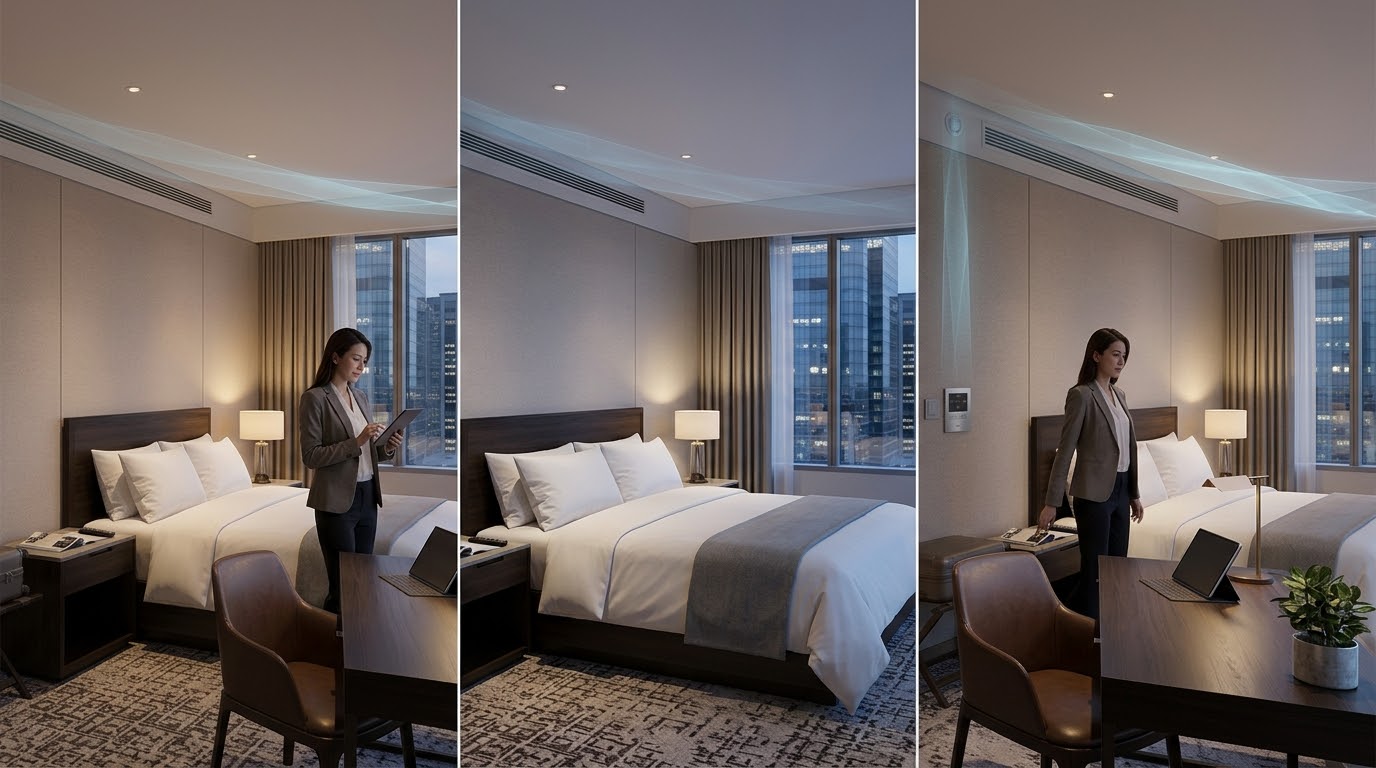
Hotel Energy Efficiency Solutions: 15 Ways to Reduce Energy Costs Without Sacrificing Guest Comfort
Energy is one of the costs hotels have to manage every day, whether occupancy is high or low.
Guestrooms still need to be maintained. Kitchens operate. Laundry runs. Hot water is produced. Common areas need lighting and climate control. HVAC equipment continues working around the clock.
That creates an important distinction:
Hotels cannot simply use less energy. They need to use energy where and when it is actually needed.
The U.S. ENERGY STAR program says U.S. hotels and motels spend about 6% of operating costs on energy. It also identifies heating and cooling, lighting and other building systems as major opportunities for reducing consumption.
For hotel owners, that makes energy efficiency more than a sustainability initiative.
It is an operational and financial strategy.
The challenge is doing it without creating uncomfortable rooms, disrupting operations or putting unnecessary workload on engineering teams.
This guide explains the most practical hotel energy efficiency solutions, where hotels should start and how to evaluate whether an energy-saving project makes financial sense.
Why Hotel Energy Efficiency Is a Profitability Issue
Hotels are different from many commercial buildings because they operate continuously.
A typical hotel may contain:
- guest rooms
- restaurants
- kitchens
- laundry facilities
- meeting rooms
- swimming pools
- fitness centers
- offices
- corridors
- lobbies
- parking facilities
- mechanical rooms
Each area has different operating patterns and energy requirements.
ENERGY STAR notes that hotels operate 24 hours a day and that their varied facilities create numerous opportunities for energy savings.
This means the biggest opportunity isn't necessarily finding one piece of equipment that uses too much energy.
It is identifying where energy is being consumed unnecessarily.
For example:
A guestroom may be empty, but the HVAC system is still maintaining a tight temperature.
A conference room may be empty, but lighting and air conditioning remain active.
A hotel corridor may have full lighting during periods of very low traffic.
A kitchen appliance may remain powered during periods when it isn't required.
Individually, these inefficiencies may look small.
Across a 100-, 300- or 500-room property, they can become a significant operating expense.
Where Do Hotels Use the Most Energy?
Energy consumption varies significantly by property.
A resort with multiple restaurants, pools and laundry facilities will have a different energy profile from a limited-service hotel.
Climate also matters.
So does the building envelope, HVAC technology, occupancy, operating schedule and hotel amenities.
ENERGY STAR identifies lighting and cooling among major electricity uses in hotels, while heating and cooling are especially important targets for energy-management improvements.
This is why hotel energy efficiency should begin with measurement rather than assumptions.
Before investing in technology, determine:
When is it being consumed?
Which loads can actually be controlled?
What is the financial value of reducing them?
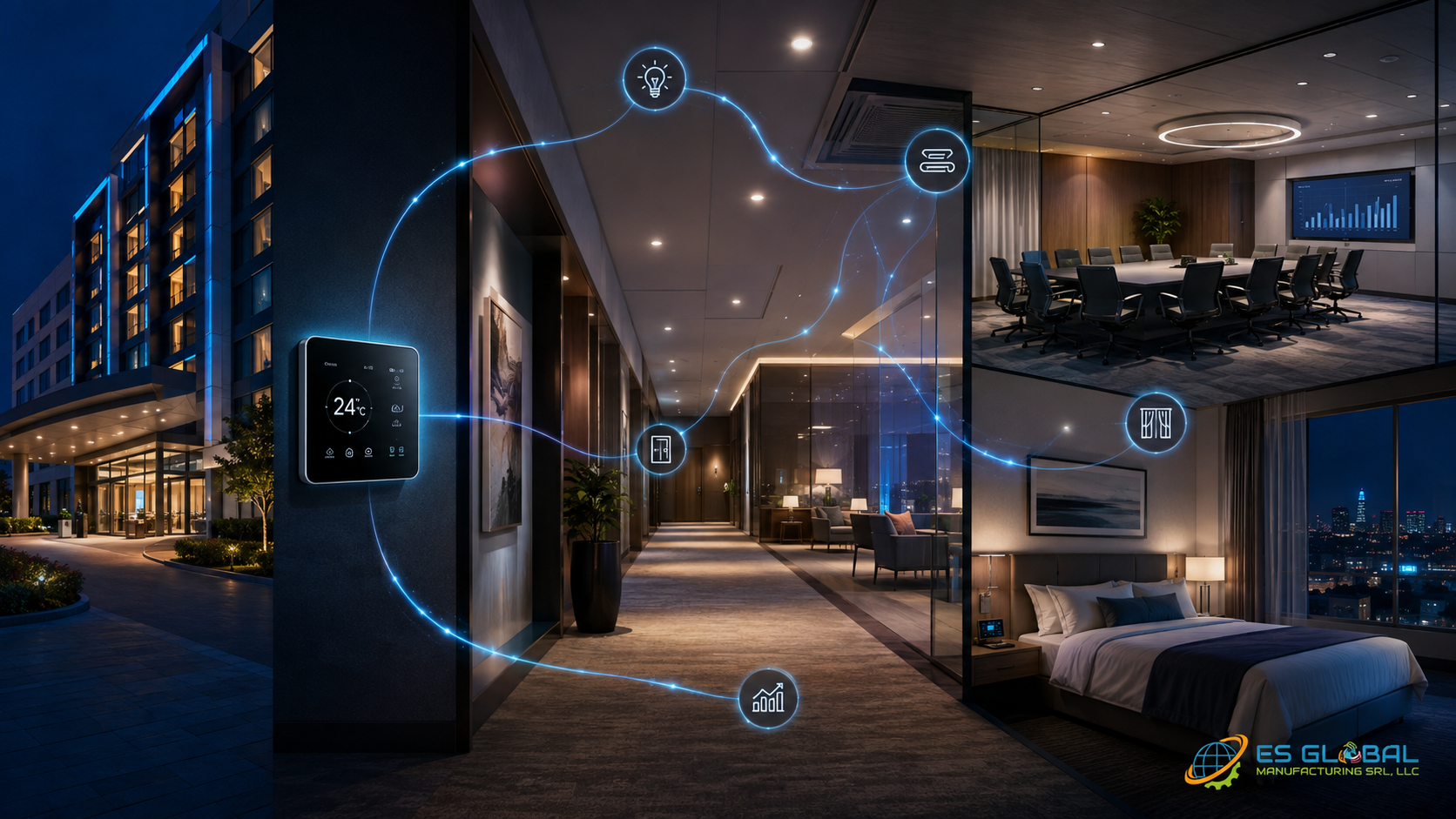
15 Hotel Energy Efficiency Solutions
1. Optimize Guestroom HVAC
Guestroom HVAC is one of the first areas hotel engineering teams should investigate.
The issue isn't necessarily that the equipment is inefficient.
It may be that the equipment is operating when the room doesn't require the same level of conditioning.
Consider a guest who leaves the room at 9:00 AM and returns at 7:00 PM.
If the HVAC system maintains the occupied temperature throughout those ten hours, the hotel is conditioning an empty room.
A better strategy is to use room status and occupancy information to adjust HVAC operation.
ENERGY STAR specifically recommends linking energy-management systems with reservation and checkout systems so hotels can reduce unnecessary conditioning in unsold rooms and prepare rooms before guest arrival.
2. Use Occupancy-Based HVAC Control
Occupancy-based control is one of the most direct hotel energy-saving strategies.
The system detects whether a room is occupied and adjusts HVAC operation accordingly.
A simplified strategy is:
Occupied → Comfort mode
Vacant → Energy-saving mode
Guest returns → Recovery
The goal isn't necessarily to turn the HVAC completely off.
Instead, the system can use controlled temperature setbacks while the room is vacant.
This is especially relevant to hotels because guestroom occupancy changes continuously throughout the day.
Our first ES Global article covers this subject in greater detail:
Hotel Occupancy-Based HVAC Control: How It Saves Energy Without Sacrificing Guest Comfort
3. Improve HVAC Maintenance
Energy efficiency doesn't always require new technology.
Sometimes the problem is maintenance.
Dirty filters, blocked airflow, poorly maintained coils and equipment operating outside its intended condition can increase energy use and reduce comfort.
ENERGY STAR recommends regular filter inspection and HVAC tune-ups as part of hotel energy-efficiency management.
Hotel engineering teams should establish maintenance schedules for:
- filters
- coils
- fans
- motors
- dampers
- sensors
- thermostats
- refrigerant systems
- control equipment
A control system cannot compensate for severely degraded mechanical equipment.
4. Review Hotel HVAC Temperature Setpoints
Temperature settings have a direct relationship with HVAC demand.
But this is an area where hotels need to be careful.
A more aggressive temperature setting may reduce energy consumption, but it can also affect guest comfort.
Instead of imposing uncomfortable limits, hotels should establish:
- reasonable occupied-room ranges
- appropriate vacant-room setbacks
- recovery strategies
- guest override rules
The objective should be controlled efficiency, not simply the lowest possible temperature in summer or highest possible temperature in winter.
5. Reduce Energy Use in Unoccupied Areas
Guestrooms aren't the only spaces that become vacant.
Hotels also have:
- meeting rooms
- banquet halls
- offices
- corridors
- storage areas
- service areas
These spaces don't necessarily need the same lighting and HVAC operation when nobody is using them.
Hotels can use:
- occupancy sensors
- scheduling
- zoning
- automated controls
- dimming
- centralized monitoring
to align energy use with actual demand.
6. Upgrade Hotel Lighting
Lighting is another significant energy-efficiency opportunity.
ENERGY STAR states that lighting can represent almost a quarter of electricity consumed in a typical hotel and notes that lighting retrofits can substantially reduce lighting electricity use depending on the starting point.
LED upgrades can therefore be valuable.
But don't stop at replacing bulbs.
Look at the entire lighting strategy.
Ask:
- Which lights need to operate 24/7?
- Which areas have predictable schedules?
- Which areas are frequently unoccupied?
- Can lights be dimmed?
- Can occupancy sensors be used?
- Can daylight reduce artificial lighting?
The best solution is often a combination of efficient fixtures and better control.
7. Use Lighting Controls
An efficient light that operates unnecessarily is still consuming energy.
Lighting controls can help hotels respond to:
- occupancy
- daylight
- time of day
- operating schedules
For example, a corridor doesn't necessarily need the same lighting level during every hour of the night.
Similarly, meeting-room lighting can be controlled according to actual use.
This is a simple example of the broader principle:
Efficiency improves when energy consumption follows demand.
8. Improve Water Heating Efficiency
Energy efficiency in hotels isn't limited to electricity.
Water heating can be a significant energy load, especially in full-service hotels.
Consider:
- guestrooms
- kitchens
- laundry
- restaurants
- spas
- pools
Hotels can evaluate:
- water-heating equipment
- insulation
- circulation systems
- temperature settings
- leaks
- heat recovery opportunities
The goal is to provide the required hot water while minimizing unnecessary energy loss.
9. Reduce Hot-Water Losses
A hotel can produce hot water efficiently and still waste energy through distribution.
Common areas to investigate include:
- poorly insulated pipes
- leaks
- inefficient circulation
- excessive hot-water demand
- outdated fixtures
Maintenance teams should monitor hot-water systems continuously rather than treating them as a set-and-forget asset.
10. Improve Kitchen Energy Efficiency
Hotel kitchens can contain multiple high-energy appliances operating for long periods.
Look at:
- ovens
- refrigeration
- freezers
- dishwashers
- exhaust systems
- cooking equipment
- ice machines
The first question isn't always "Should we replace the equipment?"
It can be:
Is this equipment operating when it isn't needed?
Operational scheduling, maintenance and equipment selection can all contribute to lower energy consumption.
11. Optimize Laundry Operations
Laundry can become a significant energy and water consumer in hotels.
Review:
- washing temperatures
- dryer operation
- machine loading
- linen policies
- equipment efficiency
- operating schedules
Even small operational changes can become meaningful when repeated across thousands of loads.
The key is to balance efficiency with the hotel's cleanliness and service standards.
12. Monitor Hotel Energy Consumption
You cannot optimize what you cannot measure.
A hotel should know:
- total energy consumption
- energy consumption by building or area
- peak demand
- seasonal patterns
- consumption per occupied room
- unusual changes
- equipment performance
Energy monitoring can help engineering teams identify anomalies before they become expensive problems.
It also creates a baseline for evaluating energy-saving projects.
13. Benchmark Hotel Energy Performance
Raw consumption numbers don't tell the entire story.
A 500-room hotel will naturally consume more energy than a 100-room hotel.
Instead, hotels can compare performance using appropriate metrics such as:
Energy per occupied room
Energy per square foot
Energy Use Intensity (EUI)
ENERGY STAR's benchmarking framework provides hotel energy-use metrics that can help properties understand performance relative to comparable buildings.
Benchmarking can answer an important question:
Is our hotel actually using more energy than it should for a property of this type?
14. Use a Hotel Energy Management System
A hotel energy management system can bring multiple energy-control functions together.
Depending on the system, it may manage or monitor:
- guestrooms
- HVAC
- occupancy
- temperature
- lighting
- energy consumption
- alerts
- equipment status
The important distinction is between monitoring and control.
Monitoring tells you what happened.
Control allows the system to change what happens.
The strongest energy-management strategy often combines both.
ES Global’s hotel energy management solutions are designed to support hotel HVAC energy management, optimize room-level energy consumption, and improve overall guest room energy efficiency.
15. Measure ROI Before Scaling
Not every energy-saving project deserves immediate property-wide deployment.
Start with the numbers.
For a potential project, estimate:
Current annual energy cost
↓
Controllable energy load
↓
Expected reduction
↓
Annual financial savings
↓
Project investment
↓
Simple payback
Then consider:
- maintenance
- installation disruption
- incentives
- equipment lifespan
- operational benefits
- guest experience
A pilot can be useful when the expected savings are uncertain.
Which Hotel Energy Efficiency Projects Should You Do First?
Not every hotel should start with the same project.
A useful prioritization framework is:
Priority 1 — Low-cost operational improvements
Examples:
- maintenance
- scheduling
- temperature management
- lighting schedules
- housekeeping procedures
Priority 2 — High-waste controllable loads
Examples:
- vacant-room HVAC
- unoccupied meeting-room HVAC
- unnecessary lighting
- poorly scheduled equipment
Priority 3 — Automation
Examples:
- occupancy-based HVAC
- smart controls
- energy-management systems
- centralized monitoring
Priority 4 — Capital upgrades
Examples:
- major HVAC replacement
- chillers
- boilers
- building-envelope improvements
- major plant upgrades
This sequence matters.
A hotel shouldn't automatically spend millions replacing equipment if a significant amount of avoidable energy waste can first be addressed through better control.
How to Reduce Hotel Energy Costs Without Affecting Guest Comfort
This should be the central rule behind every hotel energy-efficiency project:
Save energy where the guest doesn't need it, not where the guest depends on it.
For example:
Good approach
Guest leaves → HVAC setback → guest returns → room recovers.
Poor approach
Guest enters → room is uncomfortable → guest changes thermostat to maximum → HVAC runs aggressively.
The first approach reduces waste.
The second may create both energy waste and guest dissatisfaction.
A recent hospitality energy study from EHL similarly emphasizes that energy-efficiency measures can reduce operating costs without sacrificing guest comfort when they are implemented properly.
Hotel Energy Efficiency vs. Hotel Energy Management
These terms are related but not identical.
Energy efficiency
Means using less energy to deliver the same service.
For example:
Efficient lighting → same illumination with less electricity.
Energy management
Means continuously managing when, where and how energy is consumed.
For example:
Occupancy detection → HVAC changes according to room status.
A hotel can improve efficiency without having sophisticated energy management.
But combining the two can create a stronger long-term strategy.
When Should a Hotel Consider a Smart Energy Management System?
A hotel should consider a smart energy-management system when it has a combination of:
- significant guestroom HVAC consumption
- large numbers of guestrooms
- variable occupancy
- high utility costs
- limited visibility into room energy use
- frequent HVAC operation in vacant rooms
- a need for centralized monitoring
- a desire to improve energy performance without major guest disruption
The exact technology depends on the property's HVAC infrastructure.
A 50-room boutique hotel and a 500-room resort should not necessarily use the same system architecture.
What Should Hotel Owners Ask Before Buying an Energy-Efficiency Solution?
Before selecting a vendor, ask:
1. What problem are we actually solving?
Is it HVAC runtime?
Lighting?
Hot water?
Energy visibility?
Peak demand?
2. What is our baseline?
Without a baseline, ROI is difficult to validate.
3. What equipment do we already have?
Compatibility matters.
4. Does the solution require replacement or retrofit?
This can dramatically change project cost.
5. How disruptive is installation?
For an operating hotel, room downtime has financial implications.
6. How will savings be measured?
Ask for a clear measurement methodology.
7. What happens when technology fails?
Understand fallback operation.
8. How does the system protect guest comfort?
This should be a central evaluation criterion.
9. Can engineering monitor performance?
Visibility helps identify problems.
10. What is the property-specific payback?
Don't rely exclusively on generic savings claims.
How to Build a Hotel Energy Efficiency Roadmap
A practical roadmap can look like this:
Phase 1 — Measure
Establish the energy baseline.
Phase 2 — Identify
Find the largest controllable sources of waste.
Phase 3 — Prioritize
Rank projects by:
Impact × Cost × Complexity × Payback
Phase 4 — Pilot
Test promising technologies or operational changes.
Phase 5 — Measure
Compare actual performance against the baseline.
Phase 6 — Scale
Expand successful projects.
Phase 7 — Continuously Optimize
Monitor performance and adjust the strategy as operating conditions change.
This is more sustainable than treating energy efficiency as a one-time project.
How ES Global Fits Into Hotel Energy Efficiency
ES Global's strongest relevance is in hotel room energy management and HVAC energy control.
According to the supplied competitive analysis, ES Global's EHA solution is positioned as a wireless, thermostat-free energy-saving system that does not require thermostat replacement and is designed to work across A/C types. The report also identifies turnkey installation and the ability for rooms to remain live during installation as key differentiators.
The same analysis identifies:
- 20% savings guarantee
- no thermostat replacement
- 90-day money-back guarantee
- fast/non-disruptive installation
- 25+ years of experience
as ES Global strengths.
These claims should always be evaluated against the specific hotel's baseline, HVAC infrastructure and project conditions.
For hotels considering energy efficiency improvements, the broader lesson is simple:
You don't necessarily need to replace every HVAC component to start improving energy performance.
Sometimes the biggest opportunity is controlling the equipment the hotel already has more intelligently.
The Best Hotel Energy Efficiency Strategy Is Property-Specific
There is no universal list of upgrades that will produce the same result at every hotel.
A coastal resort in Florida has a different energy profile from a limited-service hotel in a colder climate.
A 100-room property has different operating economics from a 1,000-room resort.
A hotel with PTAC units has different retrofit requirements from a property using VRF or centralized HVAC.
That is why the process should always begin with:
Measure → Analyze → Prioritize → Implement → Verify
rather than:
Buy technology → install → hope for savings.
Final Takeaway
The most effective hotel energy efficiency solutions don't force hotels to choose between lower energy costs and a better guest experience.
They aim to eliminate unnecessary energy use.
That can mean:
- controlling HVAC in vacant guestrooms
- improving HVAC maintenance
- optimizing temperature settings
- upgrading lighting
- automating unoccupied spaces
- improving water heating
- monitoring energy consumption
- benchmarking performance
- implementing energy-management systems
- measuring ROI before scaling
ENERGY STAR's hotel guidance makes the same broader point: hotels have many energy-saving opportunities across HVAC, lighting, water heating and operations, and these improvements can support lower operating costs while maintaining guest benefits.
We Didn't Build A Smart Building System. We Built A Fix For One Specific Problem.
Let's Talk About Your Property.
Preguntas frecuentes
What are hotel energy efficiency solutions?
Hotel energy efficiency solutions are technologies, operational practices and equipment improvements that help hotels reduce unnecessary energy consumption while maintaining required services, comfort and operational performance.
What is the biggest energy-saving opportunity for hotels?
It depends on the property. HVAC, lighting, water heating and other building systems can all represent significant opportunities. ENERGY STAR specifically identifies heating/cooling and lighting as important areas for hotel energy savings.
How can hotels reduce energy costs without affecting guest comfort?
Hotels should focus on eliminating energy use when it isn't needed rather than simply reducing comfort levels. Occupancy-based HVAC control, intelligent temperature setbacks, pre-conditioning and automated lighting can help align energy consumption with actual demand.
Is a hotel energy management system worth it?
It can be, particularly for properties with significant HVAC consumption, variable occupancy and limited visibility into room-level energy use. The decision should be based on the property's baseline, controllable load, project cost and expected payback.
How can hotels reduce HVAC energy consumption?
Hotels can improve maintenance, optimize temperature settings, reduce HVAC operation in vacant rooms, use occupancy-based controls, improve scheduling and consider energy-management systems.
Can hotels improve energy efficiency without replacing their HVAC systems?
Yes. Some improvements involve controls, scheduling, maintenance and monitoring rather than equipment replacement. Retrofit-friendly energy-management solutions can also add control functionality to existing HVAC infrastructure, depending on compatibility.
How should hotels measure energy efficiency?
Useful metrics can include total energy consumption, energy per occupied room, energy per square foot and Energy Use Intensity (EUI). ENERGY STAR provides benchmarking resources for hotel properties.
What should a hotel do before investing in an energy-saving system?
Establish an energy baseline, identify major controllable loads, evaluate the existing HVAC and building systems, estimate the financial opportunity, and define how savings will be measured.
Más del blog

What Empty Hotel Rooms Cost You in HVAC Waste | ES Global
Learn how to estimate what unoccupied hotel rooms are costing your property in wasted HVAC energy, u...
Hotel Energy Monitoring System: Find Hidden Energy Waste
A hotel energy monitoring system helps hotel teams see where, when and how energy is being consumed....
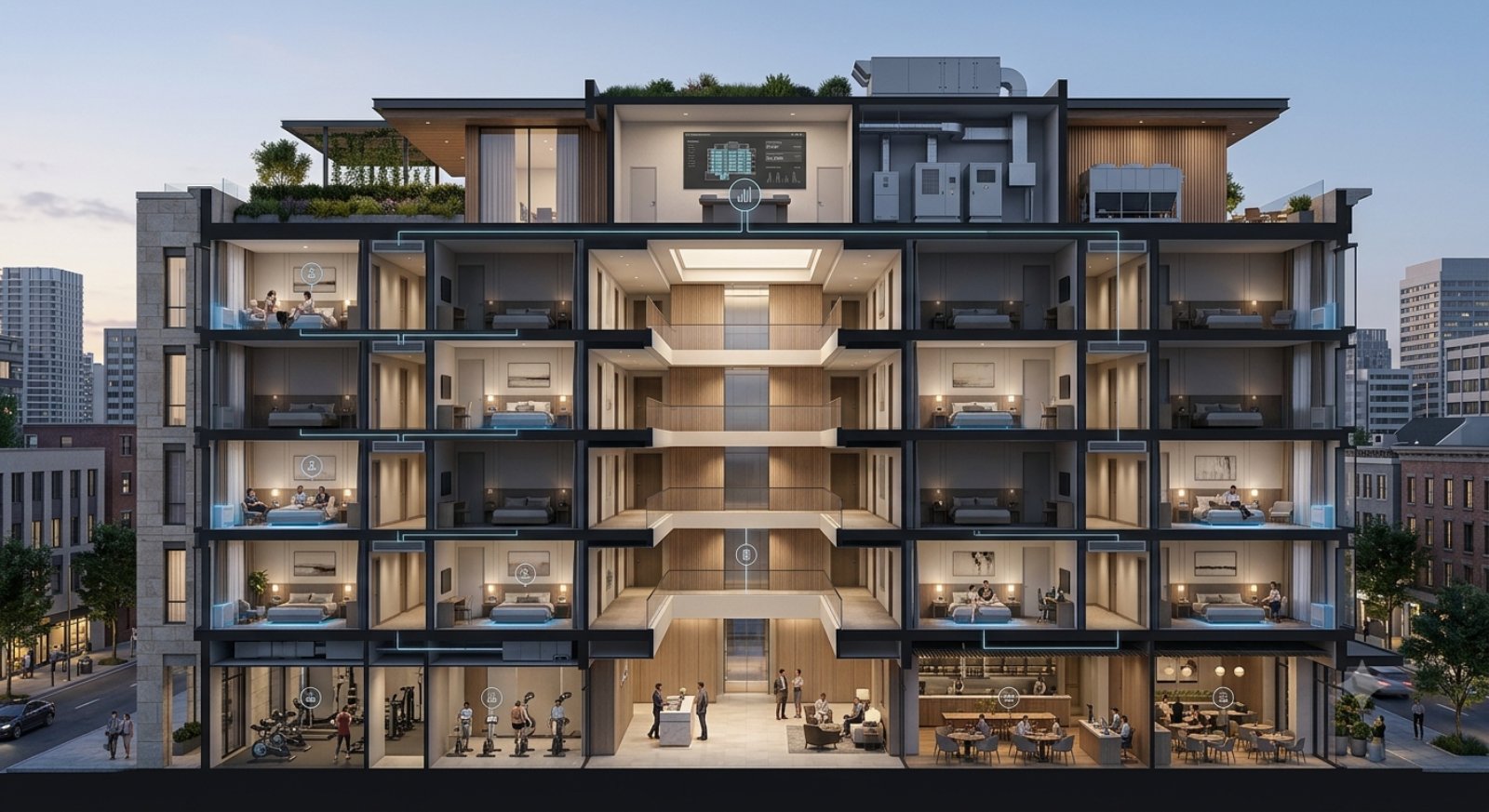
Hotel Occupancy-Based HVAC Control: Save Energy
Discover how hotel energy monitoring systems help identify hidden energy waste, track HVAC and room-...